January 13, 2026
By
.jpeg)
The start of January is often riddled with post-celebration blues, the unenthusiastic gathering of energies to return to work, and the distinctly mundane task of packing away Christmas decorations. But on the first Sunday of January in Coventry, a day of joy for the Coventry Ordinariate Mission as five came forward to be baptised by Bishop David. "It was a joyful and beautiful moment for those being baptised, for the Ordinariate Mission and for me personally.” said Fr Paul Burch, reflecting on the occasion.
At the heart of the celebration was a family: mum and dad, and two teenagers - four lives entering the Church together. Alongside them came a fifth person, James, in his mid-thirties. Five baptisms. Five deliberate “yeses.” And, as Fr Paul put it, “a real privilege to accompany them.”
The family’s story is increasingly familiar in today’s Britain. Not one of rejection of faith, but more of absence. They had not been raised with a living faith, though there were faint threads - a lapsed Catholic grandparent, a distant childhood connection to the church building which Sonia (the mother of the family) had remembered coming to as a child… and to which she now returned with joy, anticipation - and her family.
They experienced Holy Week and Easter at All Souls the previous year - an intense introduction to the heart of Christian faith - and then committed themselves, over many months, to learning, prayer, and preparation. Week by week, as individuals and as a family, they took steps toward baptism.
It is the kind of story that quietly challenges despair. People do still come. Families do still arrive together. Grace still gathers households, not just individuals.
The fifth person baptised, James, came with a story of return that mirrored the theme of Epiphany itself.
His father had been baptised Catholic but long lapsed. After the death of his wife, something stirred. He came to All Souls, found welcome and friendship - but knew he could not simply slip back into the sacramental life of the Church without honesty and healing.
That journey eventually took the form of a pilgrimage with the Ordinariate from Siena to Rome, which some readers may remember following last September and October. It was a journey that was both physical and spiritual. And now, months later at the dawn of a new year, his son came forward to be baptised.
There was “a sense of both of them having a fresh beginning” as Fr Paul remarked - father and son, each responding to grace in their own way.
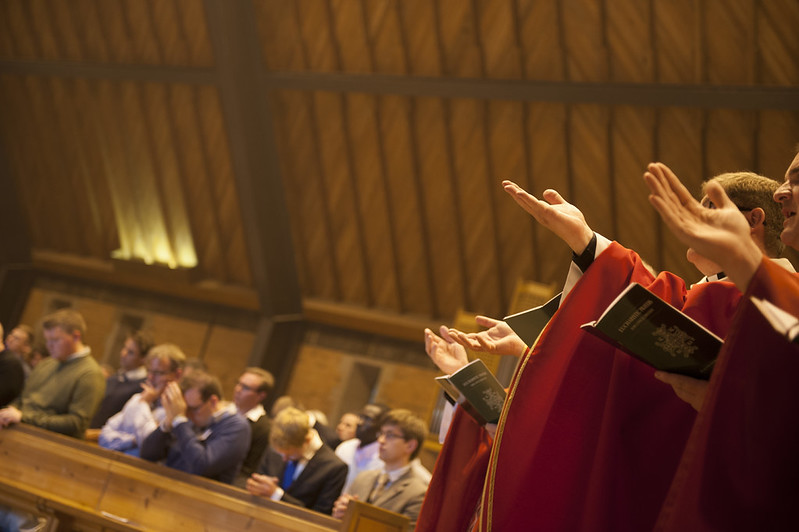
After the Mass and baptisms, the day continued with another beloved tradition: Nine Lessons and Carols, celebrated by candlelight, with Bishop David in attendance.
For those unfamiliar with it, Nine Lessons and Carols is a service that tells the story of salvation - from humanity’s fall, through God’s promises, to the birth of Jesus - using nine short readings from Scripture interwoven with carols and hymns. First devised in 1880 by Edward White Benson, later Archbishop of Canterbury, it has since been adapted by churches around the world. The most famous version is broadcast each Christmas Eve from King’s College, Cambridge.
But at All Souls, this was not something to watch - it was something to enter.
“It’s an opportunity just to sit with the Word of God,” Fr Paul explained, “to sing beautiful hymns, and to soak up what the Incarnation really means.”
In a culture - and even within Catholic life - that is often intolerant, indifferent or passive when it comes to holy mystery, services like Nine Lessons and Carols offer something vital. They are not Mass, but they are deeply liturgical: deliberate services set aside not for explanation or efficiency, but for contemplation, beauty and encounter. They allow worshippers to dwell with Scripture and the sacred in a way that opens the heart, rather than rushing it.
Around 80 people came - an encouraging number for early January, when many assume Christmas is already over. For the Ordinariate, however, Christmastide is not a season to be wrapped up quickly, but a mystery to be lingered over.
Fr Paul is candid that ministry holds contrasts. In the same period as this joyful celebration, he also encountered more challenging pastoral moments in the parish - reminders that faith can sometimes grow thin or become purely functional.
And yet, he refuses to let that be the final word. The Epiphany baptisms point to something deeper: “the shoots of new growth are very new,” he reflected - often appearing among those with little or no prior connection to the Church.
As the candles were extinguished and the cold reclaimed the streets outside, something enduring remained. Five new Catholics. A community renewed. And a quiet, stubborn hope - rooted not in optimism, but in the simple truth that God is still calling, and people are still responding.
The start of January is often riddled with post-celebration blues, the unenthusiastic gathering of energies to return to work, and the distinctly mundane task of packing away Christmas decorations. But on the first Sunday of January in Coventry, a day of joy for the Coventry Ordinariate Mission as five came forward to be baptised by Bishop David. "It was a joyful and beautiful moment for those being baptised, for the Ordinariate Mission and for me personally.” said Fr Paul Burch, reflecting on the occasion.
At the heart of the celebration was a family: mum and dad, and two teenagers - four lives entering the Church together. Alongside them came a fifth person, James, in his mid-thirties. Five baptisms. Five deliberate “yeses.” And, as Fr Paul put it, “a real privilege to accompany them.”
The family’s story is increasingly familiar in today’s Britain. Not one of rejection of faith, but more of absence. They had not been raised with a living faith, though there were faint threads - a lapsed Catholic grandparent, a distant childhood connection to the church building which Sonia (the mother of the family) had remembered coming to as a child… and to which she now returned with joy, anticipation - and her family.
They experienced Holy Week and Easter at All Souls the previous year - an intense introduction to the heart of Christian faith - and then committed themselves, over many months, to learning, prayer, and preparation. Week by week, as individuals and as a family, they took steps toward baptism.
It is the kind of story that quietly challenges despair. People do still come. Families do still arrive together. Grace still gathers households, not just individuals.
The fifth person baptised, James, came with a story of return that mirrored the theme of Epiphany itself.
His father had been baptised Catholic but long lapsed. After the death of his wife, something stirred. He came to All Souls, found welcome and friendship - but knew he could not simply slip back into the sacramental life of the Church without honesty and healing.
That journey eventually took the form of a pilgrimage with the Ordinariate from Siena to Rome, which some readers may remember following last September and October. It was a journey that was both physical and spiritual. And now, months later at the dawn of a new year, his son came forward to be baptised.
There was “a sense of both of them having a fresh beginning” as Fr Paul remarked - father and son, each responding to grace in their own way.
After the Mass and baptisms, the day continued with another beloved tradition: Nine Lessons and Carols, celebrated by candlelight, with Bishop David in attendance.
For those unfamiliar with it, Nine Lessons and Carols is a service that tells the story of salvation - from humanity’s fall, through God’s promises, to the birth of Jesus - using nine short readings from Scripture interwoven with carols and hymns. First devised in 1880 by Edward White Benson, later Archbishop of Canterbury, it has since been adapted by churches around the world. The most famous version is broadcast each Christmas Eve from King’s College, Cambridge.
But at All Souls, this was not something to watch - it was something to enter.
“It’s an opportunity just to sit with the Word of God,” Fr Paul explained, “to sing beautiful hymns, and to soak up what the Incarnation really means.”
In a culture - and even within Catholic life - that is often intolerant, indifferent or passive when it comes to holy mystery, services like Nine Lessons and Carols offer something vital. They are not Mass, but they are deeply liturgical: deliberate services set aside not for explanation or efficiency, but for contemplation, beauty and encounter. They allow worshippers to dwell with Scripture and the sacred in a way that opens the heart, rather than rushing it.
Around 80 people came - an encouraging number for early January, when many assume Christmas is already over. For the Ordinariate, however, Christmastide is not a season to be wrapped up quickly, but a mystery to be lingered over.
Fr Paul is candid that ministry holds contrasts. In the same period as this joyful celebration, he also encountered more challenging pastoral moments in the parish - reminders that faith can sometimes grow thin or become purely functional.
And yet, he refuses to let that be the final word. The Epiphany baptisms point to something deeper: “the shoots of new growth are very new,” he reflected - often appearing among those with little or no prior connection to the Church.
As the candles were extinguished and the cold reclaimed the streets outside, something enduring remained. Five new Catholics. A community renewed. And a quiet, stubborn hope - rooted not in optimism, but in the simple truth that God is still calling, and people are still responding.