January 14, 2026
By
Bishop David Waller
Dear Brothers and Sisters,
Happy New Year!
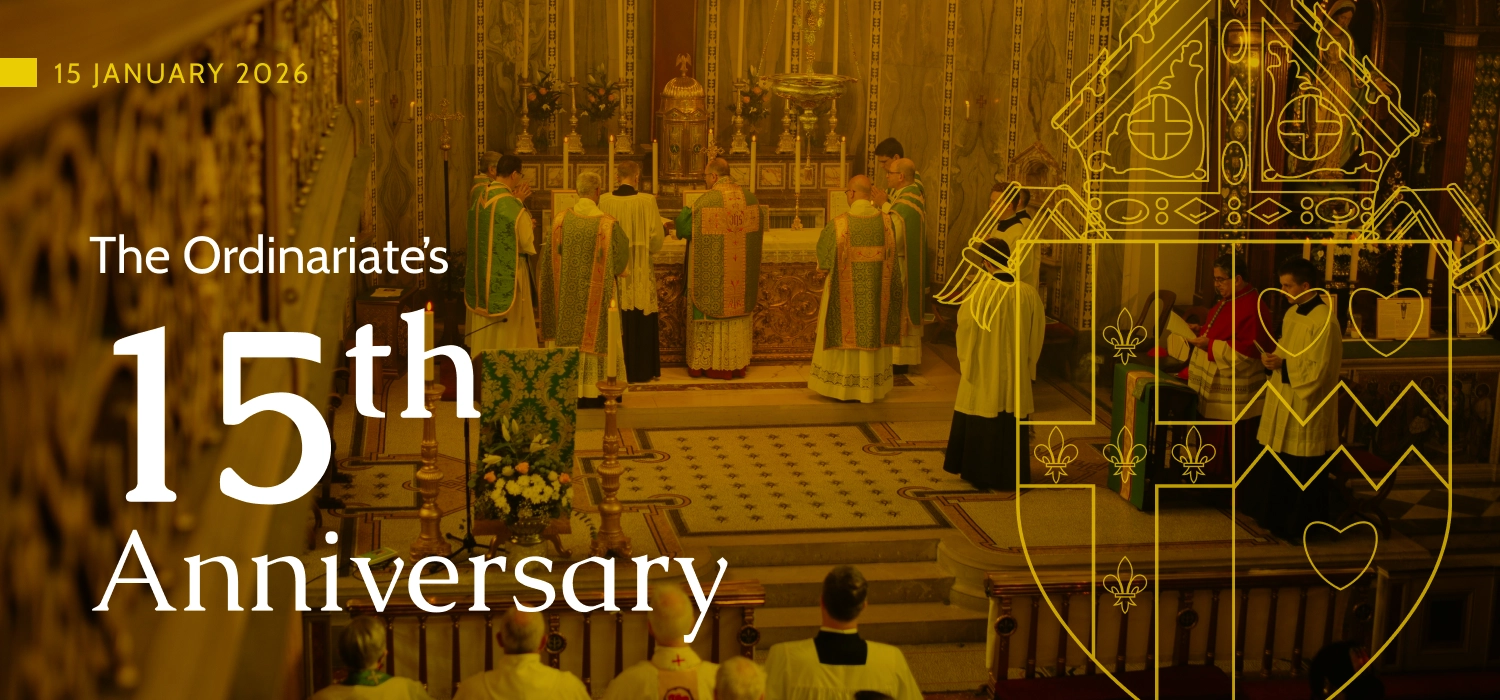
On 15th January we celebrate the 15th anniversary of the erection of the Personal Ordinariate of Our Lady of Walsingham, a few days later we begin the annual Week of Prayer for Christian Unity; as we mark these two events we need to be clear that they are connected: the Ordinariate is the realisation of that Christian Unity for which we have prayed and a model for that unity of the entire Body of Christ which has yet to be accomplished.
At the very beginning of the Apostolic Constitution Anglicanorum Coetibus, in which Pope Benedict XVI formally announced his intention to establish Personal Ordinariates for groups of Anglicans seeking unity, he beautifully explained that such a quest was the work of the Holy Spirit and he also explained how Unity is a characteristic of the Church and the successor of Peter is bound to promote and enable that unity:
In recent times the Holy Spirit has moved groups of Anglicans to petition repeatedly and insistently to be received into full Catholic communion individually as well as corporately. The Apostolic See has responded favourably to such petitions. Indeed, the successor of Peter, mandated by the Lord Jesus to guarantee the unity of the episcopate and to preside over and safeguard the universal communion of all the Churches, could not fail to make available the means necessary to bring this holy desire to realization.The Church, a people gathered into the unity of the Father, the Son and the Holy Spirit, was instituted by our Lord Jesus Christ, as “a sacrament – a sign and instrument, that is, of communion with God and of unity among all people.” Every division among the baptized in Jesus Christ wounds that which the Church is and that for which the Church exists; in fact, “such division openly contradicts the will of Christ, scandalizes the world, and damages that most holy cause, the preaching the Gospel to every creature.” Precisely for this reason, before shedding his blood for the salvation of the world, the Lord Jesus prayed to the Father for the unity of his disciples. It is the Holy Spirit, the principle of unity, which establishes the Church as a communion. He is the principle of the unity of the faithful in the teaching of the Apostles, in the breaking of the bread and in prayer. The Church, however, analogous to the mystery of the Incarnate Word, is not only an invisible spiritual communion, but is also visible; in fact, “the society structured with hierarchical organs and the Mystical Body of Christ, the visible society and the spiritual community, the earthly Church and the Church endowed with heavenly riches, are not to be thought of as two realities. On the contrary, they form one complex reality formed from a two-fold element, human and divine.” The communion of the baptized in the teaching of the Apostles and in the breaking of the eucharistic bread is visibly manifested in the bonds of the profession of the faith in its entirety, of the celebration of all of the sacraments instituted by Christ, and of the governance of the College of Bishops united with its head, the Roman Pontiff. This single Church of Christ, which we profess in the Creed as one, holy, catholic and apostolic “subsists in the Catholic Church, which is governed by the successor of Peter and by the Bishops in communion with him. Nevertheless, many elements of sanctification and of truth are found outside her visible confines. Since these are gifts properly belonging to the Church of Christ, they are forces impelling towards Catholic unity.” (Benedict XVI – Anglicanorum Coetibus).
During his 2010 visit to Great Britain, Pope Benedict, addressing the Catholic Bishops, referred to the intended Ordinariate as “Prophetic”. The Ordinariate is prophetic, because despite its smallness, it is the only example in the West of Realized Ecumenism. The Ordinariate is not some independent body “in communion with the Catholic Church” – rather it is part of the communion which is the Catholic Church. Fully part of the Catholic Church, founded by Jesus Christ and under the authority of Peter. Yet, whilst fully part of the Church, the Ordinariate retains elements of the Anglican Patrimony, it owns those things which nurtured her members and their forebears in the catholic faith during the centuries of separation. And because the Church is communion, those elements of Anglican Patrimony now belong to the whole Church as treasures to be shared.
Those who were present at my Episcopal Ordination, will have heard Cardinal Fernandez further reflect on these themes:
The path toward full participation in the gift of Apostolic Succession—with all the other treasures that our Catholic Church has in fullness—has been a central part of the journey of this Ordinariate community.
To accommodate requests from groups of Anglicans who wished to enter into full communion with the Catholic Church, the Holy See established the Ordinariate as similar to a Diocese, which the Second Vatican Council defines as “a particular church in which the one, holy, catholic, and apostolic Church of Christ is truly present and operative.”
At the same time, this “portion of the People of God” is structured to enable Anglicans, who were entering into full communion with the Catholic Church, to preserve elements of what Pope Saint Paul VI described as “the legitimate prestige and worthy patrimony of piety and usage” proper to the Anglican Communion.
These reflections highlight two crucial dimensions of the life of the Ordinariate. On the one hand, as an integral part of the Catholic Church, the Ordinariate has a mission to collaborate with other particular Churches “in which and from which the one and only Catholic Church exists.”
At the same time—in the words of the Apostolic Constitution Anglicanorum coetibus—the Ordinariate is invited to see the positive aspects of the Anglican tradition preserved in it “as a precious gift […] and as a treasure to be shared.”
The existence of the Ordinariate, thus, reflects a profound and beautiful reality about the nature of the Church and the inculturation of the Gospel, as a rich English heritage.
For, the Church is one, and the Gospel is one, but in the process of inculturation, the Gospel is expressed in a variety of cultures. In this way, the Church acquires a new face, as Pope Francis teaches in Evangelii Gaudium:
“The history of the Church shows that Christianity does not have simply one cultural expression […]. In the Christian customs of an evangelized people, the Holy Spirit adorns the Church, showing her new aspects of revelation and giving her a new face.” In this process, the Church not only gives but is also enriched. For, as Saint John Paul II taught, “every culture offers positive values and forms which can enrich the way the Gospel is preached, understood and lived.” In the case of the Ordinariate, the Catholic Faith is inculturated by people who experienced the Gospel in the context of the Anglican Communion. As they entered into full communion with the Catholic Church, it was enriched.We can say, therefore, that the Ordinariate represents one of the faces of the Church, which, in this case, receives certain elements of the rich history of the Anglican tradition: elements that are now lived out in the fullness of Catholic communion.For this same reason, when considering the unique nature of the Ordinariate, we should also always see it in the broader context of its integral participation in Catholic communion. Because of this, to remain true, its ecclesial life must always work for the unity of the Church.This happens when the Ordinariate prays, lives, and works in communion with other local Churches to favour the common growth of the spiritual life, fraternal life, and the work of evangelisation of the same territory.This collaboration favours the vital “exchange of gifts” through which—as Pope Francis teaches—“the Spirit can lead us ever more fully into truth and goodness.”( Homily of His Eminence, Cardinal Víctor Fernández for the Episcopal Ordination of Bishop David A. Waller, Bishop of the Personal Ordinariate of Our Lady of WalsinghamWestminster Cathedral, London – 22 June 2024)
Brothers and sisters, as we enter our 16th year, and as we keep the Week of Prayer for Christian Unity, let us do so with thankful hearts, full of joy in the gift of the Ordinariate. God has led us into the unity which is His Church and it is our bounden duty to be a prophetic voice, bearing witness to the Unity for which Christ prayed and by being agents for that full unity of the Body of Christ for which he longs.
In Christ,
+ David
Dear Brothers and Sisters,
Happy New Year!
On 15th January we celebrate the 15th anniversary of the erection of the Personal Ordinariate of Our Lady of Walsingham, a few days later we begin the annual Week of Prayer for Christian Unity; as we mark these two events we need to be clear that they are connected: the Ordinariate is the realisation of that Christian Unity for which we have prayed and a model for that unity of the entire Body of Christ which has yet to be accomplished.
At the very beginning of the Apostolic Constitution Anglicanorum Coetibus, in which Pope Benedict XVI formally announced his intention to establish Personal Ordinariates for groups of Anglicans seeking unity, he beautifully explained that such a quest was the work of the Holy Spirit and he also explained how Unity is a characteristic of the Church and the successor of Peter is bound to promote and enable that unity:
In recent times the Holy Spirit has moved groups of Anglicans to petition repeatedly and insistently to be received into full Catholic communion individually as well as corporately. The Apostolic See has responded favourably to such petitions. Indeed, the successor of Peter, mandated by the Lord Jesus to guarantee the unity of the episcopate and to preside over and safeguard the universal communion of all the Churches, could not fail to make available the means necessary to bring this holy desire to realization.
The Church, a people gathered into the unity of the Father, the Son and the Holy Spirit, was instituted by our Lord Jesus Christ, as “a sacrament – a sign and instrument, that is, of communion with God and of unity among all people.” Every division among the baptized in Jesus Christ wounds that which the Church is and that for which the Church exists; in fact, “such division openly contradicts the will of Christ, scandalizes the world, and damages that most holy cause, the preaching the Gospel to every creature.” Precisely for this reason, before shedding his blood for the salvation of the world, the Lord Jesus prayed to the Father for the unity of his disciples.
It is the Holy Spirit, the principle of unity, which establishes the Church as a communion. He is the principle of the unity of the faithful in the teaching of the Apostles, in the breaking of the bread and in prayer. The Church, however, analogous to the mystery of the Incarnate Word, is not only an invisible spiritual communion, but is also visible; in fact, “the society structured with hierarchical organs and the Mystical Body of Christ, the visible society and the spiritual community, the earthly Church and the Church endowed with heavenly riches, are not to be thought of as two realities. On the contrary, they form one complex reality formed from a two-fold element, human and divine.” The communion of the baptized in the teaching of the Apostles and in the breaking of the eucharistic bread is visibly manifested in the bonds of the profession of the faith in its entirety, of the celebration of all of the sacraments instituted by Christ, and of the governance of the College of Bishops united with its head, the Roman Pontiff.
This single Church of Christ, which we profess in the Creed as one, holy, catholic and apostolic “subsists in the Catholic Church, which is governed by the successor of Peter and by the Bishops in communion with him. Nevertheless, many elements of sanctification and of truth are found outside her visible confines. Since these are gifts properly belonging to the Church of Christ, they are forces impelling towards Catholic unity.”
(Benedict XVI – Anglicanorum Coetibus).
During his 2010 visit to Great Britain, Pope Benedict, addressing the Catholic Bishops, referred to the intended Ordinariate as “Prophetic”. The Ordinariate is prophetic, because despite its smallness, it is the only example in the West of Realized Ecumenism. The Ordinariate is not some independent body “in communion with the Catholic Church” – rather it is part of the communion which is the Catholic Church. Fully part of the Catholic Church, founded by Jesus Christ and under the authority of Peter. Yet, whilst fully part of the Church, the Ordinariate retains elements of the Anglican Patrimony, it owns those things which nurtured her members and their forebears in the catholic faith during the centuries of separation. And because the Church is communion, those elements of Anglican Patrimony now belong to the whole Church as treasures to be shared.
Those who were present at my Episcopal Ordination, will have heard Cardinal Fernandez further reflect on these themes:
The path toward full participation in the gift of Apostolic Succession—with all the other treasures that our Catholic Church has in fullness—has been a central part of the journey of this Ordinariate community.
To accommodate requests from groups of Anglicans who wished to enter into full communion with the Catholic Church, the Holy See established the Ordinariate as similar to a Diocese, which the Second Vatican Council defines as “a particular church in which the one, holy, catholic, and apostolic Church of Christ is truly present and operative.”
At the same time, this “portion of the People of God” is structured to enable Anglicans, who were entering into full communion with the Catholic Church, to preserve elements of what Pope Saint Paul VI described as “the legitimate prestige and worthy patrimony of piety and usage” proper to the Anglican Communion.
These reflections highlight two crucial dimensions of the life of the Ordinariate. On the one hand, as an integral part of the Catholic Church, the Ordinariate has a mission to collaborate with other particular Churches “in which and from which the one and only Catholic Church exists.”
At the same time—in the words of the Apostolic Constitution Anglicanorum coetibus—the Ordinariate is invited to see the positive aspects of the Anglican tradition preserved in it “as a precious gift […] and as a treasure to be shared.”
The existence of the Ordinariate, thus, reflects a profound and beautiful reality about the nature of the Church and the inculturation of the Gospel, as a rich English heritage.
For, the Church is one, and the Gospel is one, but in the process of inculturation, the Gospel is expressed in a variety of cultures. In this way, the Church acquires a new face, as Pope Francis teaches in Evangelii Gaudium:
“The history of the Church shows that Christianity does not have simply one cultural expression […]. In the Christian customs of an evangelized people, the Holy Spirit adorns the Church, showing her new aspects of revelation and giving her a new face.”
In this process, the Church not only gives but is also enriched. For, as Saint John Paul II taught, “every culture offers positive values and forms which can enrich the way the Gospel is preached, understood and lived.”
In the case of the Ordinariate, the Catholic Faith is inculturated by people who experienced the Gospel in the context of the Anglican Communion. As they entered into full communion with the Catholic Church, it was enriched.
We can say, therefore, that the Ordinariate represents one of the faces of the Church, which, in this case, receives certain elements of the rich history of the Anglican tradition: elements that are now lived out in the fullness of Catholic communion.
For this same reason, when considering the unique nature of the Ordinariate, we should also always see it in the broader context of its integral participation in Catholic communion. Because of this, to remain true, its ecclesial life must always work for the unity of the Church.
This happens when the Ordinariate prays, lives, and works in communion with other local Churches to favour the common growth of the spiritual life, fraternal life, and the work of evangelisation of the same territory.
This collaboration favours the vital “exchange of gifts” through which—as Pope Francis teaches—“the Spirit can lead us ever more fully into truth and goodness.”
( Homily of His Eminence, Cardinal Víctor Fernández for the Episcopal Ordination of Bishop David A. Waller, Bishop of the Personal Ordinariate of Our Lady of WalsinghamWestminster Cathedral, London – 22 June 2024)
Brothers and sisters, as we enter our 16th year, and as we keep the Week of Prayer for Christian Unity, let us do so with thankful hearts, full of joy in the gift of the Ordinariate. God has led us into the unity which is His Church and it is our bounden duty to be a prophetic voice, bearing witness to the Unity for which Christ prayed and by being agents for that full unity of the Body of Christ for which he longs.
In Christ,
+ David