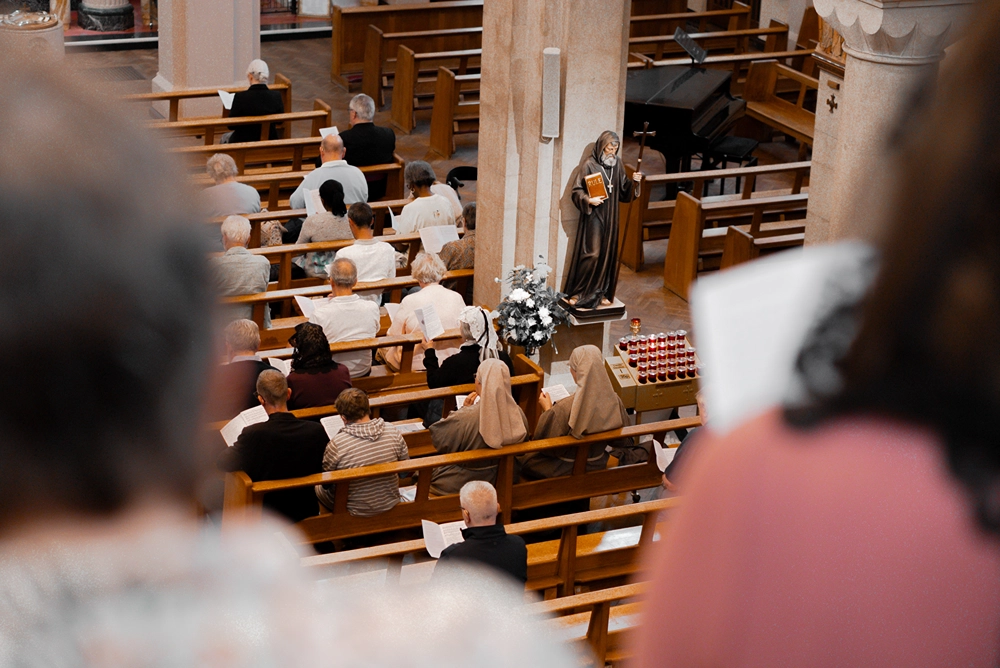
The recent document from the Dicastery for the Doctrine of the Faith has given the Church fresh language for something long known instinctively within the life of the Ordinariate: that the Anglican patrimony is “a precious gift […] and a treasure to be shared.” It speaks of beauty as evangelising, of a pastoral culture in which divine worship and daily life are intimately joined, and of a tradition that is not antiquarian but alive - received, lived, and handed on.
Nowhere is that more immediately apparent than in the realm of music and liturgy.
To encounter the Ordinariate at prayer is to encounter a tradition in which worship is not reduced to functionality, nor music treated as an accessory. Here, music belongs to the liturgy because it belongs to prayer. It is part of the offering. As Fr David Lashbrooke - Vicar General of the Personal Ordinariate of Our Lady of Walsingham - put it in our conversation on liturgy and music: “liturgy expresses our relationship with God.” And just as importantly: “it’s not a show.”
That distinction matters. In an age that instinctively turns almost everything into performance, the Ordinariate preserves a more demanding and more beautiful instinct: that sacred music exists not to entertain an audience, but to draw souls into the mystery of God. Fr David put it bluntly in speaking of carol services: “If someone leaves thinking they’ve been to a carol concert, we’ve manifestly failed.” The aim, rather, “is to draw people into the great mystery of the Incarnation.”
This is precisely the kind of insight the Roman document now helps illuminate. What the Ordinariate offers the wider Church is not merely a repertoire, nor a preferred aesthetic, but a whole sacramental imagination: a way of understanding that beauty can dispose the heart to truth, that music can carry doctrine, and that worship forms Christians not only by what is said, but by what is sung, repeated, remembered, and loved.
Fr David’s most suggestive point is that much of what people casually label “Anglican” in this context is, in fact, something older and deeper: part of the spiritual inheritance of these islands themselves. “It’s not a very Anglican thing. It’s a very English thing,” he said, speaking of traditions such as sung offices, carol services, and the scriptural, musical shaping of devotion. That is an important distinction. It places the Ordinariate’s liturgical life not simply in relation to the modern history of Anglicanism, but within the longer history of English Christianity: a history of plainsong and psalmody, of antiphons and processions, of cathedral foundations, parish choirs, mystery plays, vernacular devotion, and the enduring desire to let the faith be not only taught, but heard.
That wider cultural inheritance has been receiving renewed public attention. In January, The Telegraph described Evensong as “the very sound of English history,” arguing that choral worship still has a remarkable power to speak into a time of national uncertainty and cultural amnesia. At the same time, Cathedral Music Trust has been involved in a campaign to have “English Sacred Choral Music” recognised in the UK’s new inventory of intangible cultural heritage, describing it as a “living practice” with “a long, continuous history” from the medieval period to the present, expressed across denominations in liturgical worship as well as wider cultural life.
The Ordinariate stands in a particularly interesting relation to that conversation. It is not the sole guardian of this tradition, of course. But it is one of the places where it can still be seen whole: liturgy, music, scripture, doctrine, and devotion held together, not fragmented into concert culture on the one hand and utilitarian parish practice on the other. In the Ordinariate, the tradition is not admired from a distance. It is inhabited.
That is why hymnody matters so much. Fr David observed that “English spirituality” is often found most vividly “in our hymnody.” He is right. English sacred song has long done more than ornament devotion; it has taught the faith, lodged scripture in the memory, and cultivated reverence through poetry. George Herbert, metrical psalmody, ancient Latin hymns reborn in English dress, the great Victorian and Edwardian corpus, the carol tradition: all of these belong to a world in which doctrine was not merely explained, but sung until it became part of the inner life.
That instinct is missionary, not nostalgic. Fr David spoke movingly about the danger of allowing words like “English” to be emptied of spiritual meaning and claimed by narrower ideological projects. “We stop talking about spirituality,” he said. “We stop talking about English spirituality.” The Ordinariate’s musical and liturgical life quietly resists that impoverishment. It says that the faith of this land has a sound: reverent, scriptural, contemplative, incarnational. Not strident, not tribal, not self-enclosed, but ordered to the glory of God.
One sees this especially in the liturgical shape of Advent and Christmas, though the principle is evergreen. Fr David described the Advent carol service as a procession through scripture: from darkness to light, from prophecy to promise, from Isaiah to the Magnificat, ending not in cosy sentiment but in eschatological longing, even with Benediction and the great Advent cry of “Lo! he comes with clouds descending.” “It takes you from hope to realization,” he said.
This is not seasonal decoration. It is theology enacted through music, light, text, and silence.
And that, perhaps, is the heart of it. The Ordinariate’s liturgical music is not important merely because it is beautiful, though it often is. It is important because it embodies a way of receiving the faith. It assumes that people can be led gently and deeply into mystery; that scripture should be given its full resonance; that worship should take time; that beauty and truth belong together; that music offered “simply for the glory of God” changes those who offer it.
The Roman document has now named this reality with unusual clarity. The Anglican patrimony, lived in Catholic communion, is a gift to the Church’s mission today. In music and liturgy, that gift becomes audible. It is heard in the seriousness with which hymnody is chosen, in the conviction that liturgy is offering rather than performance, in the confidence that beauty still evangelises, and in the old but ever-new belief that what is sung with the lips may indeed be believed in the heart.
Lorem ipsum dolor sit amet, consectetur adipiscing elit, sed do eiusmod tempor incididunt ut labore et dolore magna aliqua. Ut enim ad minim veniam, quis nostrud exercitation ullamco laboris nisi ut aliquip ex ea commodo consequat. Duis aute irure dolor in reprehenderit in voluptate velit esse cillum dolore eu fugiat nulla pariatur.
Block quote
Ordered list
Unordered list
Bold text
Emphasis
Superscript
Subscript
Lorem ipsum dolor sit amet, consectetur adipiscing elit, sed do eiusmod tempor incididunt ut labore et dolore magna aliqua. Ut enim ad minim veniam, quis nostrud exercitation ullamco laboris nisi ut aliquip ex ea commodo consequat. Duis aute irure dolor in reprehenderit in voluptate velit esse cillum dolore eu fugiat nulla pariatur.
Block quote
Ordered list
Unordered list
Bold text
Emphasis
Superscript
Subscript
.jpg)
Lorem ipsum dolor sit amet, consectetur adipiscing elit, sed do eiusmod tempor incididunt ut labore et dolore magna aliqua. Ut enim ad minim veniam, quis nostrud exercitation ullamco laboris nisi ut aliquip ex ea commodo consequat. Duis aute irure dolor in reprehenderit in voluptate velit esse cillum dolore eu fugiat nulla pariatur.
Block quote
Ordered list
Unordered list
Bold text
Emphasis
Superscript
Subscript
Lorem ipsum dolor sit amet, consectetur adipiscing elit, sed do eiusmod tempor incididunt ut labore et dolore magna aliqua. Ut enim ad minim veniam, quis nostrud exercitation ullamco laboris nisi ut aliquip ex ea commodo consequat. Duis aute irure dolor in reprehenderit in voluptate velit esse cillum dolore eu fugiat nulla pariatur.
Block quote
Ordered list
Unordered list
Bold text
Emphasis
Superscript
Subscript
Lorem ipsum dolor sit amet, consectetur adipiscing elit, sed do eiusmod tempor incididunt ut labore et dolore magna aliqua. Ut enim ad minim veniam, quis nostrud exercitation ullamco laboris nisi ut aliquip ex ea commodo consequat. Duis aute irure dolor in reprehenderit in voluptate velit esse cillum dolore eu fugiat nulla pariatur.
Block quote
Ordered list
Unordered list
Bold text
Emphasis
Superscript
Subscript
Lorem ipsum dolor sit amet, consectetur adipiscing elit, sed do eiusmod tempor incididunt ut labore et dolore magna aliqua. Ut enim ad minim veniam, quis nostrud exercitation ullamco laboris nisi ut aliquip ex ea commodo consequat. Duis aute irure dolor in reprehenderit in voluptate velit esse cillum dolore eu fugiat nulla pariatur.
Block quote
Ordered list
Unordered list
Bold text
Emphasis
Superscript
Subscript
Lorem ipsum dolor sit amet, consectetur adipiscing elit, sed do eiusmod tempor incididunt ut labore et dolore magna aliqua. Ut enim ad minim veniam, quis nostrud exercitation ullamco laboris nisi ut aliquip ex ea commodo consequat. Duis aute irure dolor in reprehenderit in voluptate velit esse cillum dolore eu fugiat nulla pariatur.
Block quote
Ordered list
Unordered list
Bold text
Emphasis
Superscript
Subscript

Lorem ipsum dolor sit amet, consectetur adipiscing elit, sed do eiusmod tempor incididunt ut labore et dolore magna aliqua. Ut enim ad minim veniam, quis nostrud exercitation ullamco laboris nisi ut aliquip ex ea commodo consequat. Duis aute irure dolor in reprehenderit in voluptate velit esse cillum dolore eu fugiat nulla pariatur.
Block quote
Ordered list
Unordered list
Bold text
Emphasis
Superscript
Subscript
Lorem ipsum dolor sit amet, consectetur adipiscing elit, sed do eiusmod tempor incididunt ut labore et dolore magna aliqua. Ut enim ad minim veniam, quis nostrud exercitation ullamco laboris nisi ut aliquip ex ea commodo consequat. Duis aute irure dolor in reprehenderit in voluptate velit esse cillum dolore eu fugiat nulla pariatur.
Block quote
Ordered list
Unordered list
Bold text
Emphasis
Superscript
Subscript
.jpg)
Lorem ipsum dolor sit amet, consectetur adipiscing elit, sed do eiusmod tempor incididunt ut labore et dolore magna aliqua. Ut enim ad minim veniam, quis nostrud exercitation ullamco laboris nisi ut aliquip ex ea commodo consequat. Duis aute irure dolor in reprehenderit in voluptate velit esse cillum dolore eu fugiat nulla pariatur.
Block quote
Ordered list
Unordered list
Bold text
Emphasis
Superscript
Subscript
Lorem ipsum dolor sit amet, consectetur adipiscing elit, sed do eiusmod tempor incididunt ut labore et dolore magna aliqua. Ut enim ad minim veniam, quis nostrud exercitation ullamco laboris nisi ut aliquip ex ea commodo consequat. Duis aute irure dolor in reprehenderit in voluptate velit esse cillum dolore eu fugiat nulla pariatur.
Block quote
Ordered list
Unordered list
Bold text
Emphasis
Superscript
Subscript

Lorem ipsum dolor sit amet, consectetur adipiscing elit, sed do eiusmod tempor incididunt ut labore et dolore magna aliqua. Ut enim ad minim veniam, quis nostrud exercitation ullamco laboris nisi ut aliquip ex ea commodo consequat. Duis aute irure dolor in reprehenderit in voluptate velit esse cillum dolore eu fugiat nulla pariatur.
Block quote
Ordered list
Unordered list
Bold text
Emphasis
Superscript
Subscript

Lorem ipsum dolor sit amet, consectetur adipiscing elit, sed do eiusmod tempor incididunt ut labore et dolore magna aliqua. Ut enim ad minim veniam, quis nostrud exercitation ullamco laboris nisi ut aliquip ex ea commodo consequat. Duis aute irure dolor in reprehenderit in voluptate velit esse cillum dolore eu fugiat nulla pariatur.
Block quote
Ordered list
Unordered list
Bold text
Emphasis
Superscript
Subscript
Lorem ipsum dolor sit amet, consectetur adipiscing elit, sed do eiusmod tempor incididunt ut labore et dolore magna aliqua. Ut enim ad minim veniam, quis nostrud exercitation ullamco laboris nisi ut aliquip ex ea commodo consequat. Duis aute irure dolor in reprehenderit in voluptate velit esse cillum dolore eu fugiat nulla pariatur.
Block quote
Ordered list
Unordered list
Bold text
Emphasis
Superscript
Subscript
Lorem ipsum dolor sit amet, consectetur adipiscing elit, sed do eiusmod tempor incididunt ut labore et dolore magna aliqua. Ut enim ad minim veniam, quis nostrud exercitation ullamco laboris nisi ut aliquip ex ea commodo consequat. Duis aute irure dolor in reprehenderit in voluptate velit esse cillum dolore eu fugiat nulla pariatur.
Block quote
Ordered list
Unordered list
Bold text
Emphasis
Superscript
Subscript
Lorem ipsum dolor sit amet, consectetur adipiscing elit, sed do eiusmod tempor incididunt ut labore et dolore magna aliqua. Ut enim ad minim veniam, quis nostrud exercitation ullamco laboris nisi ut aliquip ex ea commodo consequat. Duis aute irure dolor in reprehenderit in voluptate velit esse cillum dolore eu fugiat nulla pariatur.
Block quote
Ordered list
Unordered list
Bold text
Emphasis
Superscript
Subscript

Lorem ipsum dolor sit amet, consectetur adipiscing elit, sed do eiusmod tempor incididunt ut labore et dolore magna aliqua. Ut enim ad minim veniam, quis nostrud exercitation ullamco laboris nisi ut aliquip ex ea commodo consequat. Duis aute irure dolor in reprehenderit in voluptate velit esse cillum dolore eu fugiat nulla pariatur.
Block quote
Ordered list
Unordered list
Bold text
Emphasis
Superscript
Subscript
Lorem ipsum dolor sit amet, consectetur adipiscing elit, sed do eiusmod tempor incididunt ut labore et dolore magna aliqua. Ut enim ad minim veniam, quis nostrud exercitation ullamco laboris nisi ut aliquip ex ea commodo consequat. Duis aute irure dolor in reprehenderit in voluptate velit esse cillum dolore eu fugiat nulla pariatur.
Block quote
Ordered list
Unordered list
Bold text
Emphasis
Superscript
Subscript

